Showing posts with label lesson plans. Show all posts

Monday, June 25, 2012

Doing Dewey

After Grade 4 students investigated several Dewey Decimal 100s categories, we practiced assigning topics to those categories.

Each table received a stack of cards with information like "You want to find crafts to make at your birthday party" and "You want to find a map of Japan." Students worked together to figure out where they'd go to find the information and paste them into the correct column of their "gameboard."

There were some heated discussions. Where would cats go versus tigers and lions? What about the history of dinosaurs?


Even if students didn't put a card in the right column, they got credit for having a good reason for choosing the one they selected. We don't all think the same way as Melvil Dewey!


Being able to categorize information is a skill that students will use in the future, from structuring writing assignments to organizing computer files.

Do YOU know which 100s to look in for the following topics?

  • You need to do a report on hurricanes.

  • You need to show your classmates how to do origami.

  • You need to find a recipe for pancakes.

  • You need to learn about what life is like in Brazil.


Monday, June 18, 2012

Beware These Dangerous Animals!

To finish up our animal research unit, the third graders read "Never Smile at a Monkey" by Steven Jenkins (which won the 2011 RICBA). We learned why we should never pet a platypus, clutch a cane toad, or go near a variety of animals who could hurt or even kill us. Did you know that the HIPPO is the deadliest land animal? Or that a spitting cobra can shoot its venom 8 feet?

Then we found the animals' ranges on a world map. Luckily, we only need to worry about black bears and beaded lizards here in North America. Africa, Australia, and the oceans have some of the deadliest animals. Make sure you never corner a cassowary!


Thursday, June 7, 2012

Interesting Animal Facts 3T - cont'd

After using the index and table of contents of animal books to find information and take notes, 3T students created posters. Everyone has now finished making their presentations and sharing some pretty interesting facts.


Dolphins have very good hearing; they can pick up sounds that people cannot hear.


Nurse sharks live close to the ocean floor.


Zebras are endangered.


Narwhals can weigh up to one ton.


Chameleons' eyes move separately; one can look forward while the other looks back.


Iguanas' tails are twice as long as their bodies.


Cougars' babies are called kittens.


Sea otters are the slowest sea mammals.


Turtles live everywhere in the world except Antarctica.


Beavers are the largest North American rodents.


Cheetahs are the world's fastest animals.


Blue whales migrate to warmer water in the winter.


Wolves prey on deer, moose, and caribou.


Chimpanzees have long fingers and short hair.


Bears can use their sharp claws to kill prey.


Great white sharks like shallow water.


Wednesday, May 23, 2012

Interesting Animal Facts - 3T

After using the index and table of contents of animal books to find information and take notes, 3T students created posters. This week they started making their presentations and are sharing some pretty interesting facts.


Mamba snakes like to hang out in trees.

Boa constrictors have jaws like rubber bands.


Black widow spiders like to hide in dark corners.

Crocodiles literally weigh a ton: 2,000 pounds.


Penguins are birds, but they can't fly.

Zebras: 30 years ago, there were 100,000 zebras; now there are only 2,000.


Koalas live in their mothers' pouches for six months after they are born.

Polar bears can drift for miles on Arctic ice.


African buffalo babies weigh 90 pounds.


Raccoons like to go in humans' trash cans (as this researcher can attest).

Tuesday, May 22, 2012

Wordling Dewey - 4G

Have you ever used Wordle? It's a neat Web program that takes words and creates a colorful collage with them; words that you enter more frequently have more prominence.

We're using it with Grade 4 as we try and figure out how Melvil Dewey divided up all of the world's knowledge into 10 main categories.

This week, 4G explored the shelves, selecting a variety of books on different topics from their assigned 100s ... and then tried to figure out just what their category was. We entered some of the topics into Wordle. As you can see below, some Dewey categories are a lot easier to figure out than others.


Wednesday, May 16, 2012

5Card Flickr

Fifth graders have been learning about the importance of giving credit to all content creators; while most students understand that you have to list text sources, they weren't aware that you also have to acknowledge where you get images.

We went over Creative Commons licensing, which web content creators use to specify how others can share their stuff. One site that uses Creative Commons is Flickr, an alternative to Google Images. Photographers can tag their images with all kinds of labels, including "5cardflickr," a game that involves choosing randomly generated pictures and then creating a story to go with them.

Here are our stories ... try playing at home!


Five Card Story: The Fortuneteller Game

a Five Card Flickr story created by 5LM

flickr photo by krutscjo

flickr photo by bionicteaching

flickr photo by bionicteaching

flickr photo by bionicteaching

flickr photo by bionicteaching

Once there was a fortuneteller, and he had a friend that was a man. He discovered a butterfly, and then he ate it. The fortunteller told the man that the frog was in his destiny. Soon enough, the frog appeared and carried the man to the lion. The lion said to go to the store of knives, where he would meet a hippie that has a knife collection. But they were all very dull, because hippies are peaceful.


Five Card Story: The Apple that Fell Down the Mountain

a Five Card Flickr story created by 5O

flickr photo by Serenae

flickr photo by katerha

flickr photo by bionicteaching

flickr photo by cogdogblog

flickr photo by kairĂ³s


Once upon a time, there was this guy who watched Annoyed Orange, and he said, "Hey! If I create an Annoyed Apple, will he be too strong to break if he falls down a mountain?" Then the guy that threw the apple down gave an inspirational speech in the living room with his workers. And the dog was thinking of eating the monkey.

Thursday, May 10, 2012

Can You Follow Directions?

Several classes this week took a break from library skills to practice LISTENING ... something that seems to have been disappearing from students' abilities lately. We played Simon(e) Says, got tricked by the attached worksheet, and discussed situations where ignoring directions can have dire consequences, such as:

Ignored Thing
Consequence
Test instructions
Bad NECAP score
Contract language
Less money than you deserve
Blender instructions
Chop off your finger, get food all over the kitchen
Recipe
Disgusting food
Parking lot signs
Crash into another car
How to pay bills
Fees and charges

Try printing out the worksheet and seeing how you do ... post your results in the comment section. Here is a Google Docs version in case you can't open the PDF above.

Friday, May 4, 2012

Dewey Decimal Order

5LM and 5O students have adopted shelves to take care of through the end of the year. Before they signed the adoption certificates for their new charges - whose names include Bella, Blob, Bubbles, and Sheldon - we had a "shelf parenting" class: Dewey Decimal review!

Test yourself ... do you know how to read call numbers? Try these quizzes created by other librarians at Quia:

Ordering Dewey Call Numbers

Ordering Decimals 

Dewey Decimal System 3

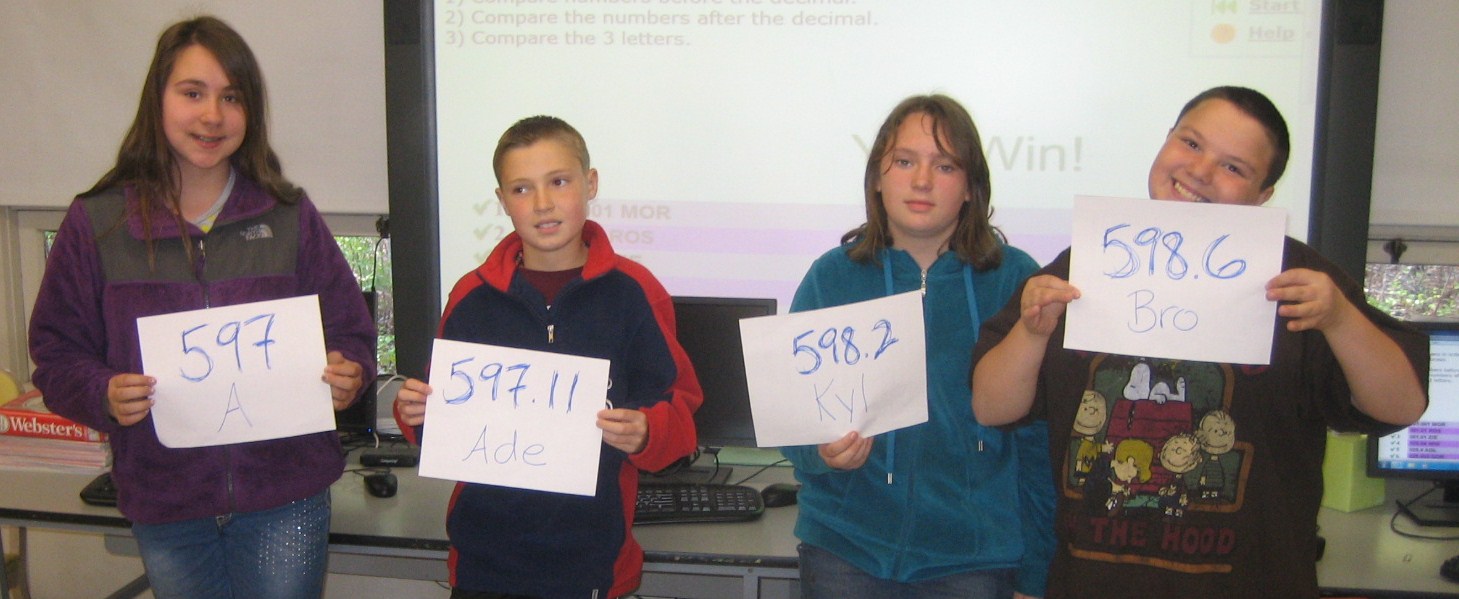
After we discussed the elements of a call number, students then put themselves in order, first in small groups, which you can see in the pictures. Then the entire class had to reorganize into one long line of call numbers.

Reading the numbers after the decimal point tripped up some students, but once they grasped the concept of going by tenths place, then hundredths, etc., (i.e., 529.235 comes before 529.4, even though 235 is a higher number than 4, because .4 can be read as .400) everyone was ready to hit the shelves.


Friday, March 9, 2012

Grade 5 Research

Writing the script
5O and 5LM students have been gathering information on a wide range of self-selected topics, including:
- How humans are threats to sharks
- The origins of the solar system
- Are pit bulls really mean and vicious?
- Hieroglyphics
- How Muppets are made
- Famous ghost sightings

    Adding design touches

    Working in groups, they are putting together paper slide shows; since we don't have enough computers in the library for everyone to access presentation software, we're going a little low-tech instead. However, we'll be recording the slide shows and posting them online, which is high-tech!

    What's a paper slide show, you ask? Here is the sample I showed the kids:


    Stay tune for our final videos! We start taping next week.